There was a time when every gamer knew exactly what an enemy would do next. Bosses followed the same attack pattern, and NPCs repeated the same dialogue every time you spoke to them, and once you completed a game, the next playthrough felt almost identical. Yet, we still loved every second of it because those games gave us unforgettable memories.
Today, gaming feels completely different. Every decision matters; enemies react to your actions, characters seem more alive than ever, and some game worlds are so unique that no two players experience them in the same way. The biggest reason behind this transformation is AI in video games.
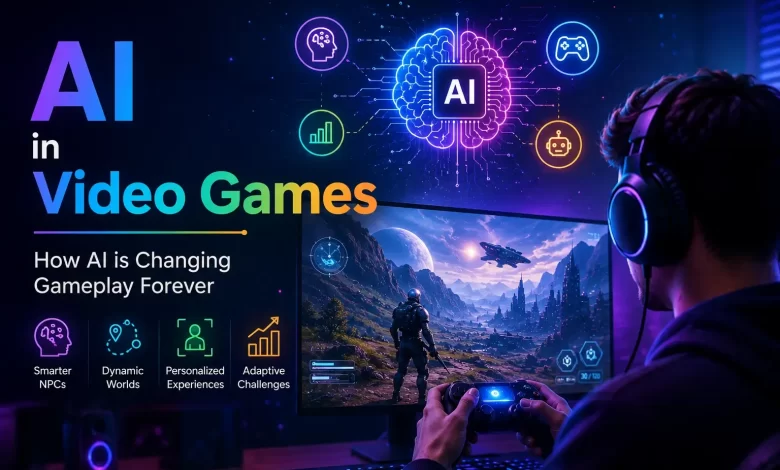
Artificial intelligence is no longer just a futuristic idea. It can become one of the biggest innovations in modern gaming, helping developers build smarter NPCs, realistic enemy behavior, dynamic game environments, procedural content generation, adaptive gameplay, and personalized gaming experiences. Instead of making games predictable, AI makes them feel alive, creating experiences that surprise players every time they pick up a controller.
Let’s explore how AI is changing gameplay and why it is shaping the future of the gaming industry.
What is AI in Video Games?
AI in video games refers to the use of artificial intelligence to make games smarter, more responsive, and engaging. Rather than following a fixed script, AI allows characters and game systems to react based on what the player does.
Years ago, game characters followed simple propaganda rules. An enemy would patrol the same route repeatedly or attack only when you entered a specific area. Once you understood the pattern, winning became easy.
Modern AI goes much further. It helps create characters that adapt, learn, and respond naturally, making every encounter feel fresh. While gaming AI isn’t the same as AI tools that can easily write text or drive cars, it is designed specifically to improve gameplay and create more immersive worlds.
How does AI Make Gameplay more Exciting?
The biggest advantage of AI is that it makes games feel less scripted and more interactive. Instead of repeating the same actions every time, AI-powered systems can change according to decisions. This means every gaming session can feel different from the last one.
Some of the biggest improvements include:
- Smarter enemies that adapt to your strategies.
- NPCs with realistic behavior and emotions.
- Dynamic difficulty adjustment.
- Personalized player experiences.
- More believable open worlds.
- Randomly generated environments and missions.
These improvements keep players engaged for much longer and greatly increase replay value.
Smarter NPCs Create more Reliable Worlds
Non-playable characters, commonly called NPCs, have evolved tremendously because of AI. Older games often featured NPCs that stood in one place and repeated the same dialogue forever. While they served their purpose, they rarely felt like real people.
Today’s AI-powered NPCs behave much more naturally. They can remember previous interactions, respond differently depending on your choices, and react to changing situations around them.
Life simulation games are excellent examples of this improvement. Characters build relationships, react emotionally, and make independent decisions based on their surroundings. This creates stories that feel unique without requiring every event to be manually scripted by developers.
As a result, players become emotionally connected to the game world rather than simply completing objectives.
AI makes Enemies Smarter without Feeling Unfair
One of the most noticeable uses of AI in video games is enemy behavior. Instead of rushing directly toward the player, modern enemies can:
- Work together as a team.
- Take cover during combat.
- Flank the player’s position.
- Retreat when overwhelmed.
- Search for the player intelligently.
- Change tactics during battle.
These behaviors make combat far more exciting because players cannot rely on memorizing attack patterns.
For example, survival horror games often use AI to build tension. Rather than following predictable movements, enemies search different locations, respond to noise, and pressure players in unexpected ways. Every encounter becomes more suspenseful because the outcome isn’t guaranteed.
Procedural Content Generation Creates Endless Adventures
One of the most impressive applications of AI is procedural content generation. Instead of developers manually designing every location, AI can automatically generate environments, quests, landscapes, buildups, and even entire planets.
This offers several benefits:
- Massive game worlds.
- Nearly endless exploration.
- Higher replay value.
- Unique experiences for every player.
- Faster content creation for developers.
Games with procedurally generated content rarely feel repetitive because AI constantly introduces new layouts and discoveries. Players can spend hundreds of hours exploring without feeling like they have seen everything the game has to offer.
Players can spend hundreds of hours exploring without feeling like they have seen everything the game has to offer.
Personalized Gaming Experiences
Every gamer has their own unique playing style. Some people enjoy playing difficult combat games, some love solving puzzles, some loves to play single player game and some love the story-based experience. AI helps games understand your preferences by analyzing how you interact with them.
For example, AI can:
- Adjust difficulty based on player performance.
- Recommend suitable quests.
- Offer helpful tutorials when needed.
- Balance enemy strength.
- Suggest equipment based on playstyle.
- Adapt challenges to match skill level.
Instead of forcing every player into the same experience, AI creates gameplay that feels tailored to each individual. This personalization keeps players engaged without making the game feel too easy or frustratingly difficult.
AI helps Developers Build Better Games
Artificial intelligence doesn’t only improve gameplay. It also helps developers create better games behind the scenes.
Testing a modern game manually can take thousands of hours. Developers must identify bugs, broken mechanics, performance issues, and unexpected player actions. AI speeds up this process by automatically testing different scenarios.
It can:
- Detect bugs quickly.
- Identify performance issues.
- Simulate thousands of player actions.
- Test different game mechanics.
- Find balancing problems before launch.
This allows studios to release more polished games while reducing development time.
Popular Games that Showcase AI at its Best
Several successful games demonstrate just how powerful AI has become.
– Middle-earth: Shadow of Mordor
The famous Nemesis System changed how players viewed enemy characters. Instead of being forgettable opponents, enemies remembered previous encounters, developed rivalries, and even returned stronger after surviving battles. Every player’s journey became unique.
– Alien: Isolation
This survival horror title uses advanced AI to create one of gaming’s smartest enemies. The alien constantly searches for the player, reacts to sounds, and changes its hunting behavior throughout the game. Because it never behaves the same way twice, every encounter feels genuinely frightening.
– The Sims 4
AI controls nearly every aspect of each Sim’s daily life. Characters develop relationships, experience emotions, react to their surroundings, and make independent decisions, creating natural stories that unfold differently every time.
– AI Dungeon
Unlike traditional games with fixed dialogue choices, AI Dungeon allows players to write almost anything they imagine. The AI responds by generating new storylines, creating nearly endless adventures driven entirely by player creativity.
Challenges of using AI in video games
Although AI brings incredible benefits, it also introduces several challenges. Developers must balance intelligent gameplay without making games frustrating. Some important considerations include:
- Maintaining fair gameplay.
- Preventing repetitive AI behavior.
- Protecting creative originality.
- Managing higher development costs.
- Optimizing performance for different hardware.
Another important discussion involves creativity. While AI can automate certain tasks, human developers remain responsible for creating memorable stories, emotional moments, and imaginative worlds that players truly connect with.
The best games will continue to combine human creativity with AI technology rather than replacing one with the other.
The future of AI in Video Games
The future of AI gaming looks incredibly exciting. As AI technology continues improving, players can expect experiences that are even more immersive. Some future innovations may include:
- NPC’s capable of natural conversations.
- Stories that change dramatically based on player decisions.
- Fully dynamic open worlds.
- AI-generated side quests.
- Realistic companions with long-term memory.
- Better accessibility features for players of all skill levels.
AI is also making game development more accessible for smaller studios. Independent developers now have access to powerful tools that help create high-quality games with fewer resources, opening the door for more creativity across the industry.
Rather than replacing game developers, AI is becoming a powerful creative partner that helps transform ambitious ideas into reality.
Final Thoughts
Gaming has always been about creating unforgettable memories. From some classic arcade adventures to today’s massive open worlds, every generation has introduced something new. Now, AI in video games is leading the next major evolution.
Whether it’s smarter enemies, believable NPCs, personalized gameplay, dynamic storytelling, or endlessly explorable worlds, artificial intelligence is making games feel more alive than ever before.
The future won’t simply feature better graphics or faster hardware. It will deliver game worlds that react, deeply, and grow alongside every player. As AI continues to evolve, one thing is certain: gaming’s most exciting chapter is only just beginning.
Frequently Asked Questions
What is AI in Video Games?
How does AI Improve Gameplay?
Which games use AI effectively?
Does AI Replace Game Developers?
What is the future of AI in Video Games?